Developing the forecast
If mussels become contaminated with algal toxins, they are not harvested by shellfish farmers to safeguard public health. Farmers can then suffer revenue losses if the mussels remain contaminated for prolonged periods. Forecasting when risks of toxin contamination in mussels are elevated could thus allow farmers to harvest them before contamination occurs.
Environmental conditions that control the growth of toxin-producing algae include sea surface temperature, salinity, water stratification, and light. These variables can be directly and indirectly monitored through the use of satellite Earth observation (EO) data and high spatial resolution ocean models. Here, we use these key environmental conditions from a coastal ocean model to forecast areas and periods with increased risk of blue mussels being contaminated by algae toxins. We intend that this forecast can help mussel farms in planning mussel harvesting.
The algal toxin forecast
The forecast uses machine learning to estimate the probability of algal toxins being detected in blue mussels seven days ahead. The forecasted thresholds are above 20 µg/kg for diarrheic shellfish toxins – DST and above 120 µg/kg for paralytic shellfish toxins – PST. The forecast model considers the current state and evolution over the last two weeks of water temperature, salinity, water-column stability, and daily light, to estimate the probability of algae toxin outbreaks.
The forecast is accessed via NERSC’s visualisation platform, NARVAL, which allows us to display and overlay multiple data products at a specified time and place: NARVAL: algal toxins probability forecast
Access the algal toxins forecast
The data
Sea surface temperature and salinity, together with N² data (a measure of the water column stability) are retrieved at a high-resolution (800 m) grid of the Norwegian coast. These data are based on the regional ocean model Norkyst-800, which combines several EO products. The algal toxin data Diathermic Shellfish Toxins (DST) and Paralytic Shellfish Toxins (PST) are provided by the Norwegian Food Safety Authority (Mattilsynet) and are used to train the model.
Using the forecast
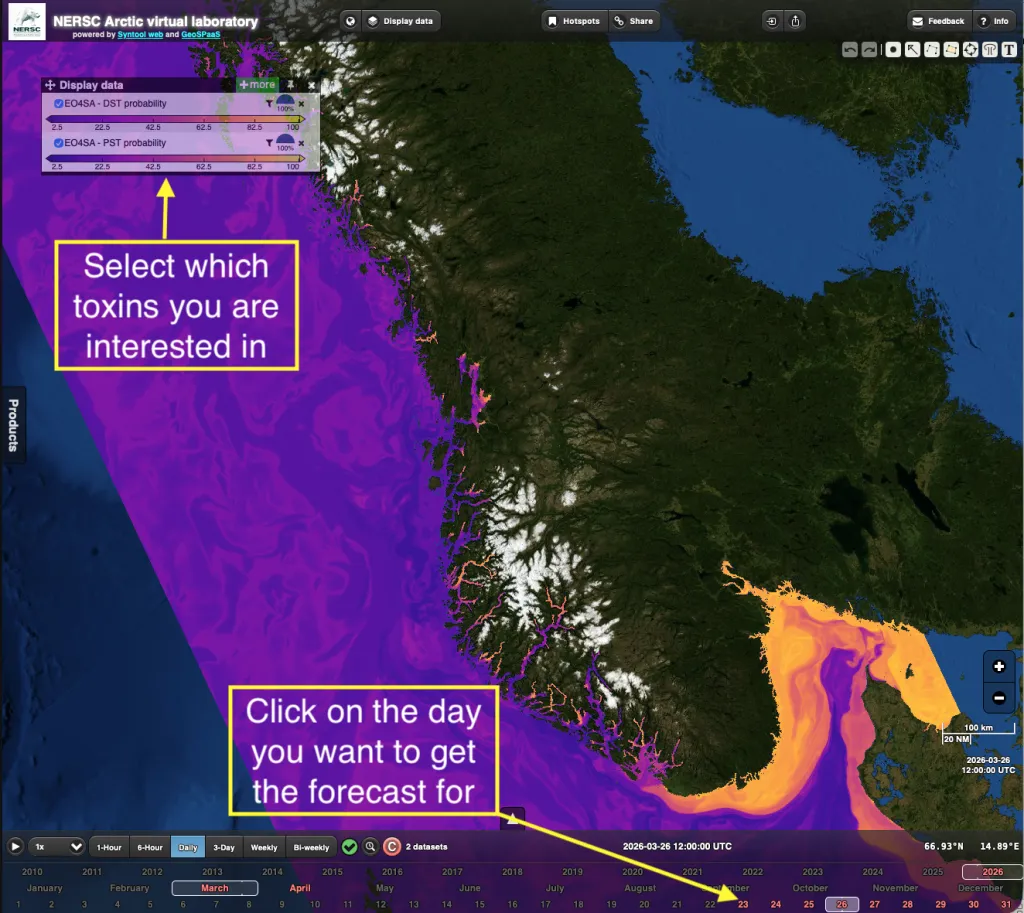
- Date and time: the forecast is updated every weekday and is available for one week ahead. The bar at the bottom can be used to select the date of the forecast you wish to see by year, month and day. Dates for which the forecast is available are highlighted in white, yellow or red.
- Display data: The box in the top left of the screen shows the two forecast products for the probability of algal toxins being detected in blue mussels one week ahead, for DST and PST. You can tick or untick the box for each product to display or hide it.
- The order of the list determines the order of the layers on the map: the product at the top of the list will be displayed the highest on the map. You can drag and drop products in this list to re-arrange the layers and change the transparency of each one by clicking on the semi circle that goes up to 100%.
Disclaimer: This product is under development, and its use should be approached with caution. We welcome any feedback on the products and the data viewer via the contact information on the Team page.
It should NOT be used to determine where to pick wild mussels or any other shellfish, or for deciding whether they are safe to eat. For official information, one should consult the Norwegian Food Safety Authority (NFSA) at https://www.mattilsynet.no/mat-og-drikke/forbrukere/blaskjellvarsel.
Flyers
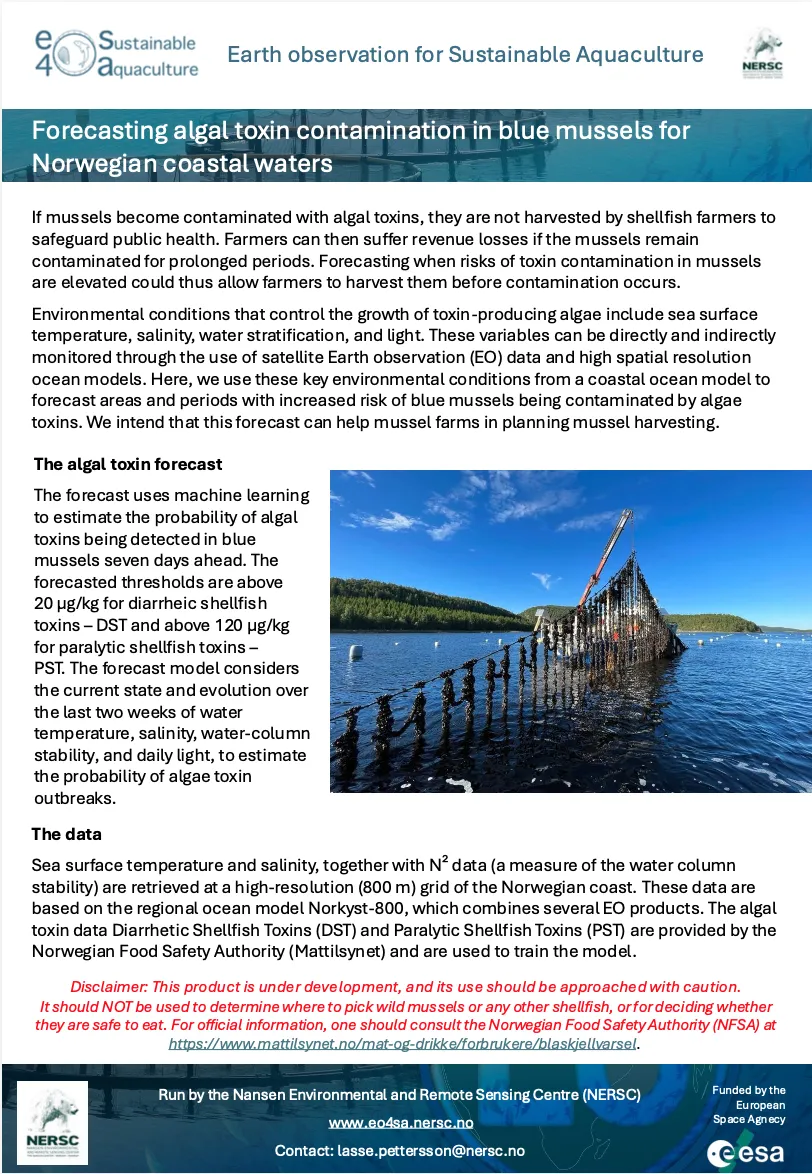
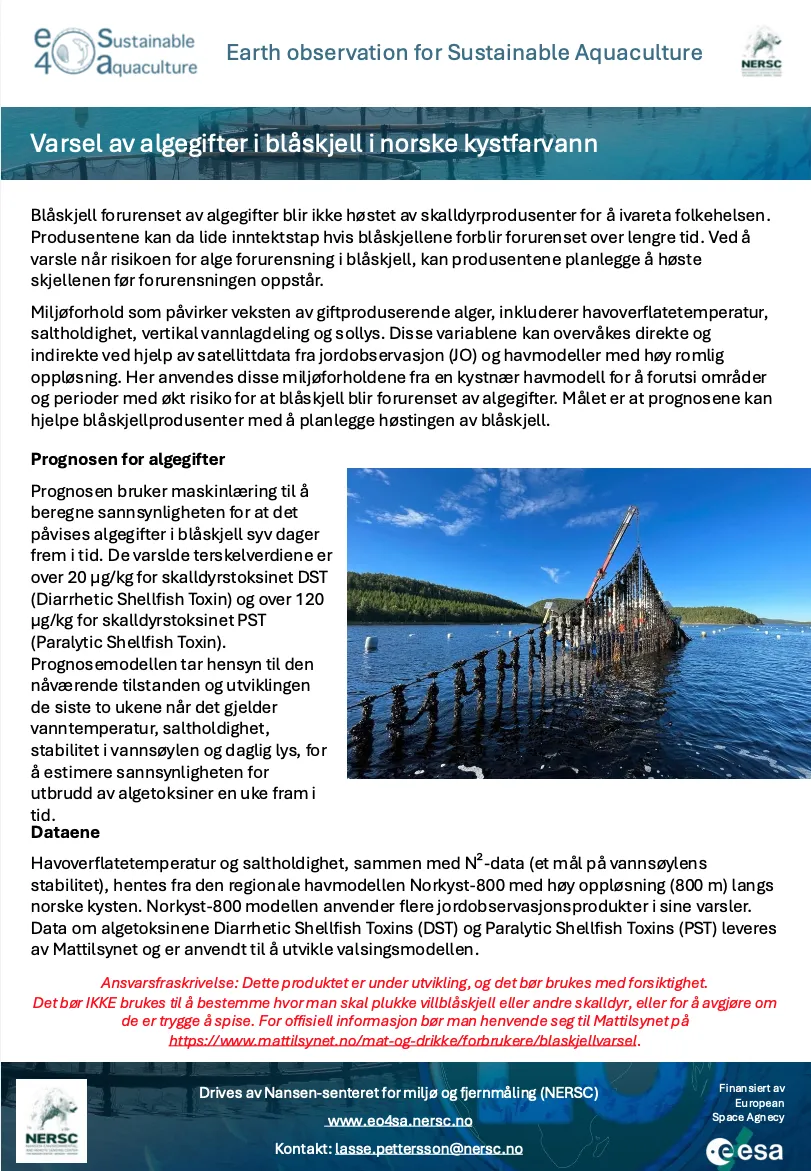
Download the information flyers (available in both English and Norwegian) for an overview on the products and how to access them.