Developing a risk model for salmon lice
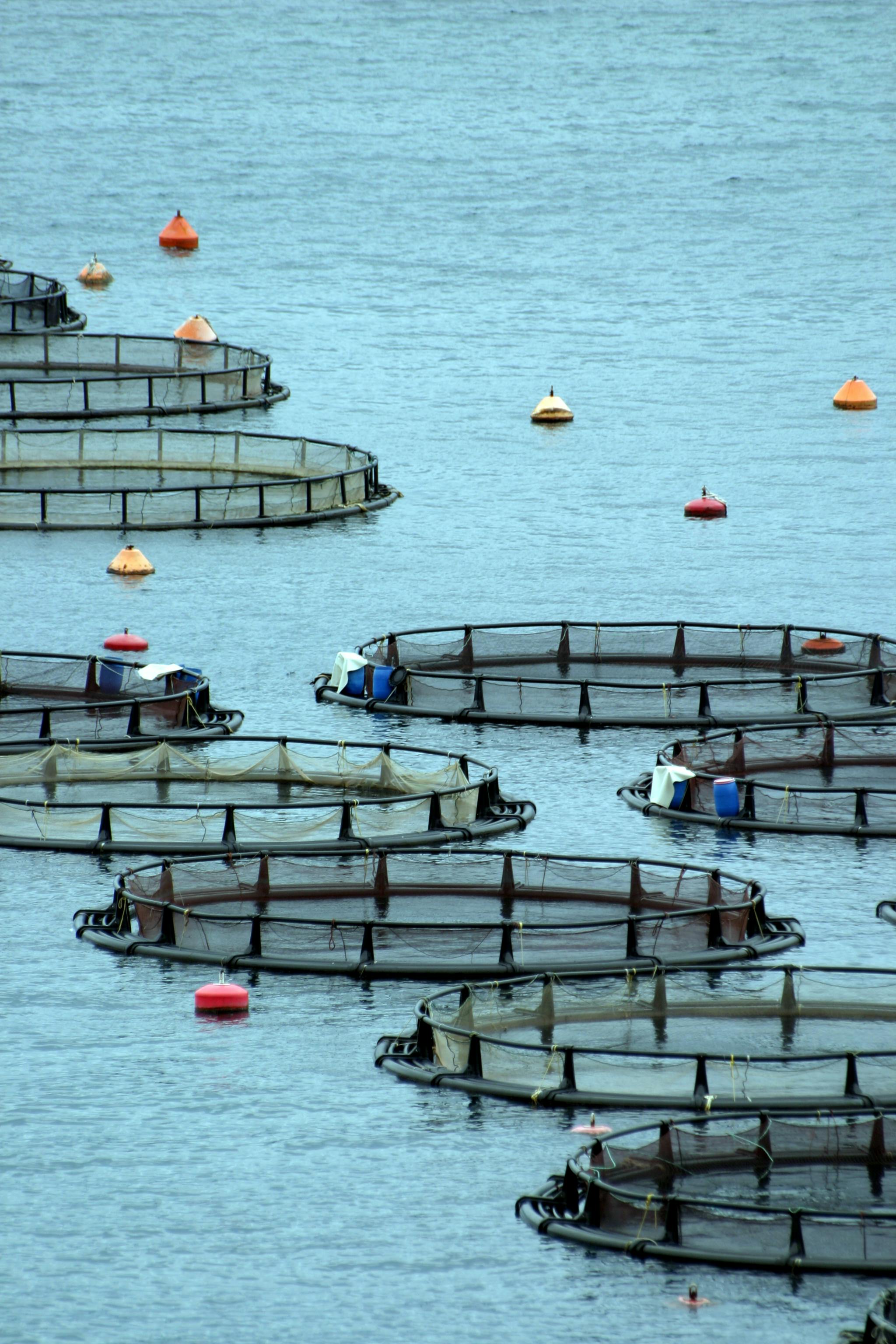
Outbreaks of salmon lice are one of the major challenges within the aquaculture industry. Therefore, all Norwegian fish farms must measure and report salmon lice conditions to the Norwegian Food Safety Authority, on a weekly basis. The environmental ocean conditions that drive salmon lice infestations can be derived from ocean coastal models with the support of Earth Observation (EO) satellites. Satellite observations of several EO products are combined to produce forecasts of ocean variables at high spatial resolution in the Norwegian coastal waters.
Here, we have taken the ocean variables sea surface temperature and salinity, together with fish farm data, to develop a model to forecast salmon lice outbreaks. We present a publicly available, weekly forecast for all Norwegian fish farms, for the probability of crossing the lice per fish thresholds that are specified by Norwegian regulations.
The salmon lice forecast
The machine-learning-based model is used to estimate the probability of a fish farm reporting adult female lice per fish reaching more than 0.2 or 0.5 in the next week. The model considers current and last month developments of sea surface temperature, sea surface salinity, lice density at different life stages (sessile, adult male, adult female), and any use of delousing methods.
The forecasts are accessed via NERSC’s visualisation platform, NARVAL, which can display and overlay multiple data products at a specified time and area: NARVAL: salmon lice probability forecasts.
Access the salmon lice forecast
The data
Input data for the model is gathered from two main sources. The current lice levels, and use of delousing for each salmon farm, is collected weekly by the Norwegian Food Safety Authority (Mattilsynet) and is available as near real time updates on the BarentsWatch website. The sea surface temperature (SST) and salinity (SSS) data are obtained from the regional ocean model Norkyst-800 at a high spatial resolution (800 m), retrieved from the Meteorologisk institutt (MET). The method is adapted from the published paper on probabilistic models for harmful algal species and further developed and validated in this project.
Using the forecast
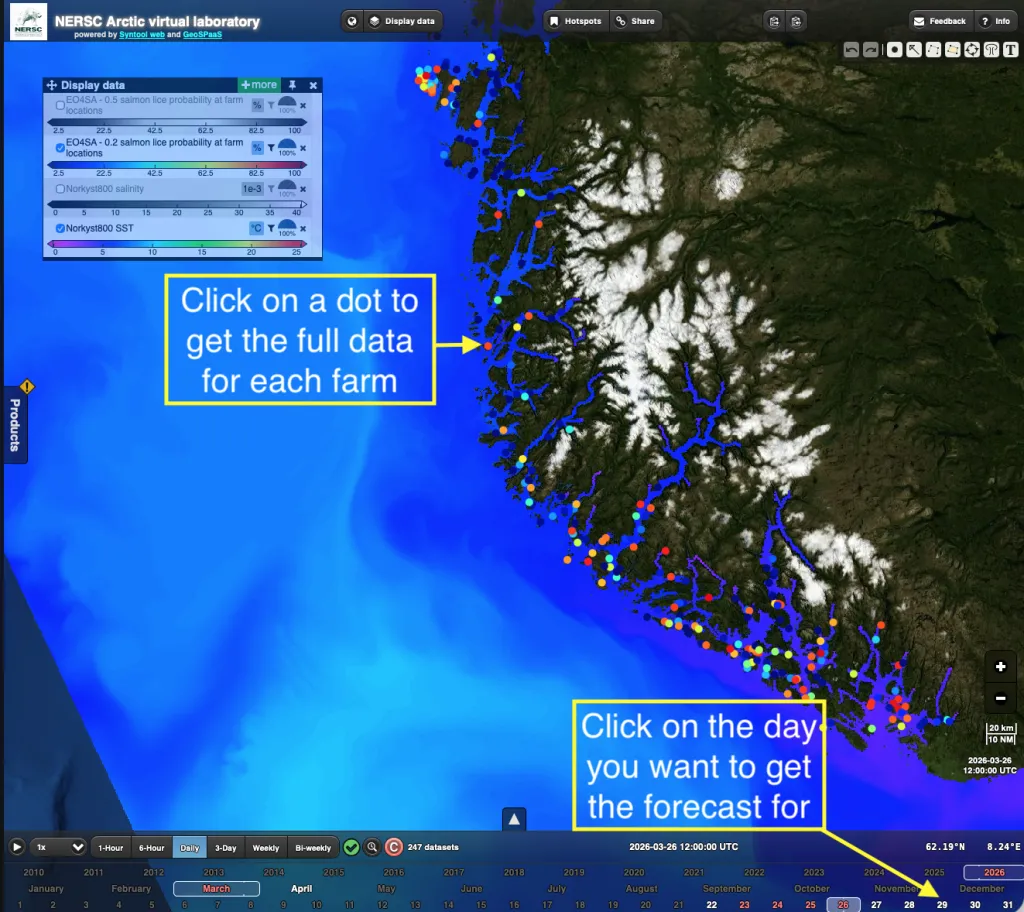
The salmon lice forecasts are provided as coloured dots, for all farm locations that have reported lice observations in the last four weeks. The forecast products show the probability of a fish farm reporting adult female lice per fish reaching more than 0.2 or 0.5 in the next week. They are available from 2nd March 2026.
Forecast features
- Display data: The box in the top left of the screen, called display data, shows the selected products: the two salmon lice forecast products and the environmental conditions (temperature and salinity). You can tick the box for each product to display or hide it.
- Each dot is an individual farm, and clicking on the dot brings up the detailed forecast for that farm along with the environmental data.
- Date and time: the forecast is updated every weekday and is available for one week ahead. The bar at the bottom can be used to select the date of the forecast by year, month and day.
These products are currently under development and should be used with caution. We welcome any feedback on the products and the data viewer via the contact information on the Team page.
Flyers
Download the information flyers (available in both English and Norwegian) for an overview on the products and how to access them.